

No helmet can protect the wearer from all foreseeable impacts. For maximum protection, the helmet must fit properly with the chin strap securely fastened and provide adequate peripheral vision.
The head measurement is a starting point for the whole sizing procedure. Due to different shapes, heads that appear to be the same size when measured with a tape may not necessarily fit the same helmet size. The circumference of the head should be measured at a point approximately one inch above the eyebrows in the front and at a point at the back of the head that results in the largest possible measurement. Take several measurements to make sure you have the largest.

Once the measure has been determined and the Bell Racing sizing chartSelect the helmet that is closest in size to the tape measure and try on the helmet. If you are between sizes, round up to the next larger size. If you wear a balaclava or head sock, always measure and fit the helmet with it.
See image 2.
If the helmet slides down on the head without resistance, you have the first indication that it may be too big. Obviously, if it does not slide down on the head, it is too small. Many people who have not worn helmets are reluctant to pull down if they encounter resistance as they put the helmet on; however, if it is simply snug, we recommend continuing to put the helmet on. Only if it is impossible to put the helmet on should you move on to the next size up, as helmets that fit well generally fit very well once they are fully on. In fact, most people will choose a helmet that is too big for them if they are left to make their own choice. Note that padding tends to break down after prolonged use, so we recommend a close-fitting helmet. Helmets that are too large may not work as intended and, in extreme cases, may come off during an accident.
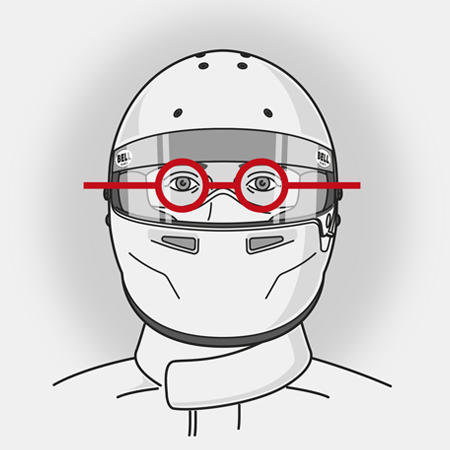
When properly fitted, the helmet should be worn low on the forehead, eyes near the centre of the eye opening, touching the top of the head with even and firm pressure all around, tight without excessive pressure points. See Illustration 3.
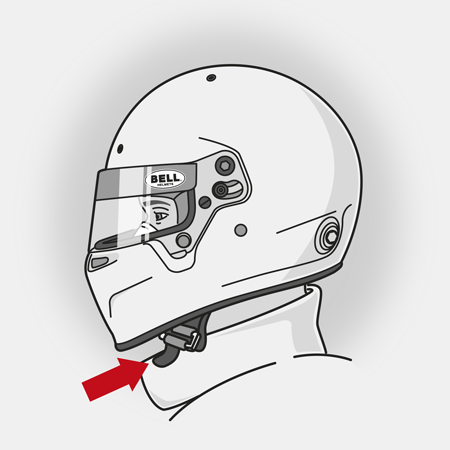
To attach the chin strap, pass the end of the strap through both D-rings, pass the end of the strap back through the inner D-ring and pull it snug against the throat. Make sure the chin strap is snug against the throat. See Illustration 4.
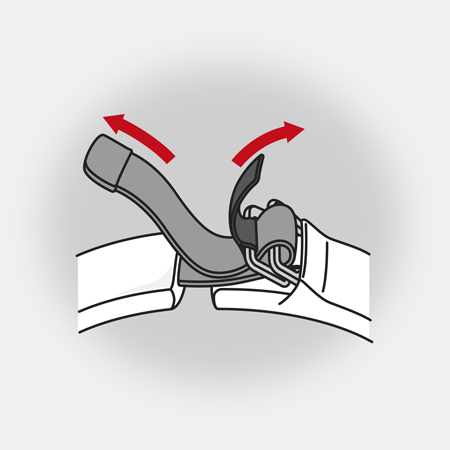
A good fit and a properly fastened chin strap are all that keep your helmet on your head during a crash. Make sure the chin strap is properly fastened and snug against your throat every time you listen to your helmet. To fasten the chinstrap correctly, fasten the chinstrap as shown in Illustration 5Then adjust the side strap until it fits snugly against your throat.
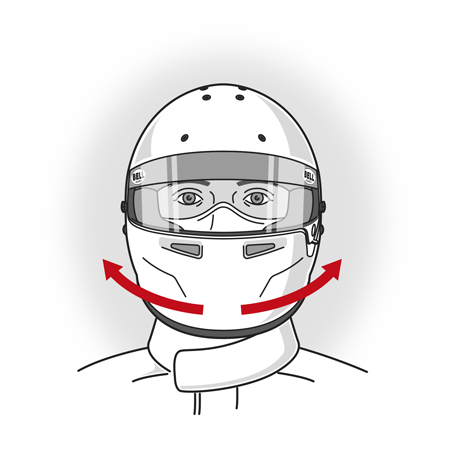
Place the helmet correctly on your head and stand in front of a mirror to check the horizontal and vertical movement. Check if the cheek pads are in contact with the cheeks. Is there excess pressure on the cheeks or are they too loose? Look for gaps between the temples and the cheek pad. Check the back of the helmet where the rolled collar (if the helmet has one) makes contact with the neck. Is it touching at all or is it pushing the helmet back causing it to roll down over the eyes in front? After this visual check, grasp the helmet with your hands, one on each side, and while holding your head steady, gently rotate the helmet first from left to right and then from front to back, as in illustrations 6 and 7. If the skin on your forehead moves with the helmet as it is rotated, the fit is adequate. If the skin on your forehead does not move when the helmet is rotated in either direction or you can lower the helmet in front of your eyes, the fit is too loose.
Check the fit of the helmet in the cheek area. If the cheek pads squeeze the cheeks causing excessive pressure, it is too tight. If the cheek pads do not contact the skin or can rock the helmet from side to side, it is too loose (Bell Racing makes cheek pad inserts to adjust the fit of the cheek pads and sells face piece accessory kits with various thicknesses of cheek pads for riders who have a standard size head but need reduced cheek pads due to a wider face or riders who have a larger head but a narrow face and need to increase the thickness of the cheek pads). Try several sizes until you find one that fits.
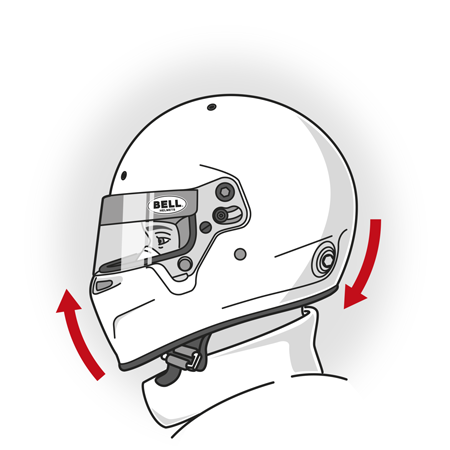
With the helmet on properly and the chin strap fastened, try to remove the helmet from your head. Hold it securely and make a serious effort to roll it forward and backward off your head, as in Figure 7. If the helmet comes off or can be rolled back far enough to expose your forehead or forward far enough to block your vision, the helmet is too loose or the straps are not tight.
If the helmet is too large or if you can still remove the helmet, DO NOT wear it and replace it with a smaller one.
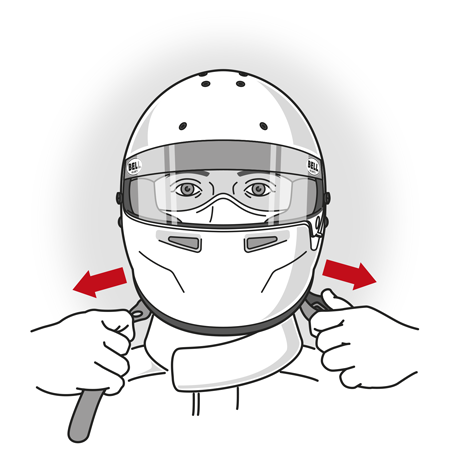
To remove the helmet, unbuckle the chin strap by pulling the red tab on the "D" ring outward (away from your face) to release the tension on the strap. See illustration 5 . To remove the helmet, grasp the chin strap halves with each hand and, while pulling outward, lift the helmet off your head.... See Illustration 2. Pull it out and lift it up from your head.
Finally, unbuckle the chin strap and remove the helmet. Immediately after removing the helmet, observe the colouring of the skin on the forehead and cheeks. A reddening of the skin in a small area may indicate a pressure point.
Pressure points are sometimes not noticed by the user for several minutes or even hours afterwards. They sometimes cause headaches and are at least uncomfortable.
If you notice a pressure point but do not remember experiencing any discomfort there while wearing the helmet, put the helmet back on for a few minutes, paying close attention to the anticipated pressure point.
If you experience discomfort at the pressure point during the time, move to the next large size and repeat steps 2 to 4.
Steps 1 to 4 are essential to get the most out of your helmet. Spend as much time as necessary to make sure you have a good fit. Only after successfully completing steps 1 through 4 should you put the helmet on and wear it for an extended period of time or take a test ride. If the helmet feels comfortable, stays securely in place, and the straps remain properly adjusted, your helmet is ready for use. If the helmet feels uncomfortable or moves excessively, follow steps 1 through 4 as necessary to correct the problem. If you cannot successfully complete all 4 steps, or if the helmet does not fit properly and does not feel comfortable, DO NOT continue to wear the helmet. Or: return to your dealer for assistance or contact Bell Racing for further instructions.
Do not wear chin protectors, use the chin strap at the tip of the chin or modify the chin strap in any way. This will increase the risk of the helmet coming off in an accident.
